The Sunward field guide
How to read an astrocartography map
Read a map in this order: check the birth details, select a theme, identify the planet and angle, then examine a city’s distance. Use the interpretation as a prompt for exploration rather than a verdict on the place.
Start with details you can reproduce
For this walkthrough, use the synthetic input 1995-06-15 at 09:30 in Asia/Shanghai. Choose Shanghai from the birth-city suggestions. This is a teaching example, not a real person's biography. The starting example in the calculator uses these details, but check the form before continuing: a map only answers for the details that were calculated.
For your own map, replace the example with your recorded birth information. After changing a field, generate the map again. Read the displayed result details to confirm that the output corresponds to your latest input; editing a field alone is not the same as completing a new calculation.
- Enter 1995-06-15 and 09:30, and select Shanghai as the birth city.
- Choose “Generate My Map” and check the birth details shown with the results.
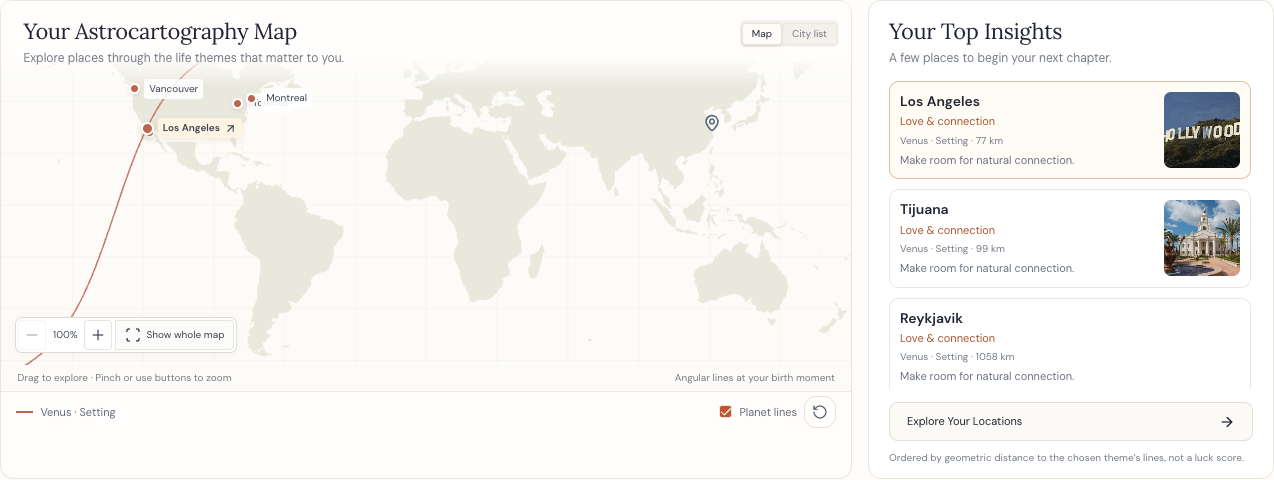
- Select “Love & connection” to concentrate on the Venus setting line.
- Select Los Angeles from the candidate cities, then read its line label, distance, and explanation.
Read a city label before interpreting its position
In this example, Los Angeles is about 77 km from Venus DSC. “Venus” identifies the celestial body; “DSC” identifies setting at the geometric horizon. The number is the shortest modeled surface distance from the city coordinate to that line. It is not a compatibility percentage or a measure of relationship quality.
Read the city explanation alongside that label. The Love & connection theme uses Venus DSC as a symbolic prompt about relationships, aesthetics, and collaboration. One practical experiment could be visiting a shared-interest gathering you would enjoy anyway, then observing whether the people and setting suit you.
Change one theme and notice what changes
Now select “Learning & growth.” The active line becomes Jupiter ASC, and Tijuana is the nearest candidate at about 259 km. Los Angeles appears at about 432 km from that line. The birth moment is unchanged; you have changed which line is used to select and order cities.
This explains why there is no universal “best city” in the interface. A candidate’s position in one theme does not describe its distance to every other line. If you return to Connection, its own ordering returns. Comparing themes helps clarify which symbolic question you are exploring.
Use the map, list, and city explanation together
The map supplies geographical context. The list makes the candidate names and distances easier to scan. Selecting a candidate focuses the map and updates the city explanation. Read the text as well as the drawing: a flat map can distort visual distance, especially at high latitudes.
“All themes” shows 6 selected thematic lines. The engine calculates 28 lines, but the current controls do not expose every planet-and-angle combination. Likewise, the 6 displayed candidates are selected from 371 destinations. A city absent from this list has not received a negative judgment.
Save the result and add your own context
Download the current report if you want a local record. It is an HTML document containing the selected theme’s candidate readings and calculation time details. Open it in a browser. Downloading needs no email; the optional email feature is separate and depends on service availability.
Alongside the report, note the theme, the question you are exploring, and practical information you still need. For a potential visit, that might include transport, accommodation, accessibility, and local activities. For a possible move, include work, residence requirements, finances, and support. The map is one reflection tool within that broader investigation.
Sources and calculation notes
Technical references below explain the calculations. Practitioner references, where included, document the interpretations attributed to them in the text. Neither type establishes that a planetary line predicts a life outcome. How we use sources